Inheritance
1. Client's Crisis
After their father passed away, the clients learned of the existence of a handwritten will that he had prepared while alive. The will stated that most of the real estate owned by their father would be bequeathed to one specific sibling (the other party). In effect, there was almost no property left for the spouse and the other children.
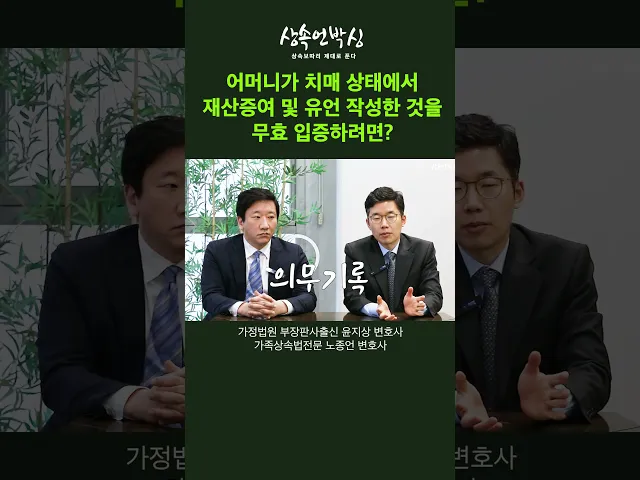
The clients had strong doubts about the authenticity of the will. At the time it was written, their father was suffering from dementia and schizophrenia, and his cognitive ability and judgment were impaired. A medical opinion letter also noted severe short-term memory and judgment problems. The handwriting in the will also appeared different from his usual writing, and while he normally used lined notebooks, the will was written on plain paper.
It was also suggested that the other party may have isolated the father from the rest of the family and taken the lead in preparing the will. The clients came to Law Firm Jonjae to recover their rightful inheritance.
2. Key Issues
The issues to be disputed in this case were divided into two layers.
First was the validity of the will. The key question was whether the father had testamentary capacity at the time of making the will—that is, the ability to understand the meaning and consequences of his actions—and whether the will was indeed written in his own hand. A will made without such capacity is invalid, and if it was not written by the father himself, it would fail to satisfy the requirements of a handwritten will.
Second, even if the will were found valid, there was the separate issue that the clients' legally guaranteed minimum share of inheritance (the reserved portion) had been infringed. Since most of the real estate had been bequeathed to the other party, it was necessary to calculate the shortfall in the reserved portion and demand its return. In this situation, it was expected that the other party would argue in response that some of the clients had received special benefits during the father's lifetime, such as unauthorized transfers of assets or withdrawals from bank deposits, so preparation for that defense was also necessary.
3. Jonjae's Strategy
Managing Partner Yoon Ji-sang and Attorney Park Jeong-eun structured the case as a dual-track lawsuit, pursuing both a claim of invalidity of the will and a claim for return of the reserved portion. If the will were found invalid, the entire inherited estate would be divided according to the statutory shares; if the will were found valid, they would still be able to recover at least the reserved portion.
For the invalidity claim, they substantiated the father's lack of testamentary capacity with the medical opinion letter, while specifically pointing out inconsistencies in the handwriting on the will and irregularities in the drafting circumstances. They also argued that there were indications the other party had led the preparation of the will while isolating the father.
During trial, a handwriting analysis by a professional expert was conducted to determine the authenticity of the will. The expert concluded that the handwriting in the will matched the father's usual handwriting. At that point, Attorney Yoon Ji-sang directly accepted the objective expert result and immediately changed strategy. The complaint was amended to withdraw the invalidity claim and focus on the claim for return of the reserved portion.
If the strategic shift is delayed, the lawsuit becomes prolonged and the client suffers unnecessary costs and emotional strain. The key judgment in this case was promptly changing direction as soon as the expert result came out and concentrating on securing practical benefits.
In calculating the reserved portion, the team also rebutted, with specific evidence, the other party's claims regarding special benefits received by the clients, and developed the argument that the clients' shortfalls in the reserved portion had to be fully recognized.
4. Outcome and Recovery
The court issued a mediation recommendation order, which became final and brought the case to a close. The main results were as follows.
The other party transferred a one-third share of the Ansan real estate to one of the clients and paid another client KRW 150 million in the nature of a reserved portion and caregiving expenses. Some of the real estate was confirmed as belonging to the other party, but certain land and financial assets were arranged to be jointly inherited equally by the clients and the other party.
Although the formal validity of the will was recognized, the dispute was fairly resolved by arranging for a substantive distribution of assets among the other heirs. The achievement in this case was that, by swiftly shifting strategy in line with the objective expert result, the clients were able to secure practical inheritance benefits.
If you are wondering how to respond in a similar situation, the outcome may differ depending on the specific facts of the case, so we recommend consulting a specialist.
Attorney in charge: Managing Partner Yoon Ji-sang · Attorney Park Jeong-eun
To protect confidentiality, some elements of this case have been de-identified to the extent that the essence of the matter is not compromised.
Watch the video on Law Firm Jonjae's YouTube 'Family Unboxing' channel
Attorney in charge


Other cases