Corporate News
The First-Instance Judgment in the Goo Hara Inheritance Property Division Trial, and the Finally Enacted 「Goo Hara Act」
— The inheritance rights of parents who abandoned child-rearing: how did the law respond?
Hello. We are the Inheritance Team at Law Firm Jonjae.
A parent who abandoned their child returns only after that child has left this world. To take the property. It is truly heartbreaking. In Korean society, this issue first came to the surface in 2019, when the late Goo Hara, a member of the girl group KARA, passed away.
Goo Hara's biological mother left the family when her daughter was around nine years old. For the next 20 years, there was no contact, no child-rearing, and no attempt at visitation or access. Yet after her daughter died, she demanded half of the inherited property. Under the current Civil Act, if a person died without a spouse or children, the parents could inherit the property half and half without any particular restriction.
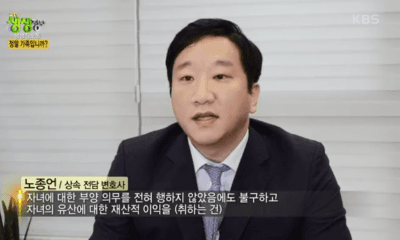
Goo Hara's older brother, Goo Ho-in, received an assignment of the inheritance share and contribution share from their father and filed a petition for a family court decision on division of inherited property against the biological mother. Attorney No Jong-eon of our Law Firm Jonjae handled the legal representation for the bereaved family and carried out this case.
Gwangju Family Court First-Instance Decision — 20% Contribution Share Recognized
In December 2020, Family Affairs Division 2 of the Gwangju Family Court (Chief Judge Nam Hae-gwang) recognized a 20% contribution share for Goo Hara's bereaved family. Accordingly, the bereaved family and the biological mother divided the estate in a 6:4 ratio rather than 5:5.
The grounds on which the court recognized the contribution share were as follows.
First, Goo Hara's father raised her alone for about 12 years without any help from the biological mother. The court held that this could not simply be regarded as part of fulfilling a duty of support.
Second, there was no indication that the biological mother attempted to visit or communicate with Goo Hara, and no basis was found to show that the father interfered with such attempts.
Third, the duty to raise a minor child is not limited to merely bearing expenses. It is a comprehensive duty to protect and educate the child for their physical and mental development. Even if Goo Hara began her singing career early and her father did not separately bear child-rearing costs, it cannot be said that he did not raise Goo Hara.
This ruling was a step forward from the mainstream precedents that had not recognized a contribution share for the circumstances in which one parent in a single-parent family raised a child alone.
Around the Same Time, Another Case — Dispute Over Bereavement Benefits for a Fallen Firefighter
As Goo Hara's case was underway in 2020, another case carrying similar pain came to light.
Mr. Kang, a firefighter rescue worker, died by suicide due to work-related stress, and his death in the line of duty was recognized. The Government Employees Pension Service paid his father about 80 million won in bereavement benefits and related payments, and under inheritance law the same amount was also paid to the biological mother, who had played no role in child-rearing after the divorce 32 years earlier.
The biological mother, who did not even attend the funeral, received the compensation for her daughter's death in the line of duty. Mr. Kang's father filed a lawsuit seeking child support, and the court ruled that about 77 million won, similar to the amount the biological mother received, should be paid as overdue child support.
The bereaved family in that case, together with Goo Hara's older brother Goo Ho-in, also held a press conference at the National Assembly urging passage of the Goo Hara Act. A structure in which a parent who abandoned their child takes the property through that child's death. It was another tragedy created by legal blind spots.
And on January 1, 2026, the 「Goo Hara Act」 took effect
In 2020, we wrote this at the end of this article: 'If the Goo Hara Act is not passed, second and third Goo Hara cases will continue to appear.'
About four years later, on August 28, 2024, the Goo Hara Act (an amendment bill to part of the Civil Act) finally passed the plenary session of the National Assembly. Of the 286 members present, 284 voted in favor, 0 against, and 2 abstained. It was effectively unanimous.
The amended Civil Act Article 1004-2 provides that when a decedent's direct ascendant has seriously violated the duty of support, or committed a serious crime or severely unfair treatment, a family court may declare the loss of inheritance rights. This law took effect on January 1, 2026, and applies retroactively to cases in which inheritance opened after April 25, 2024.
It took six years from the legislative petition to passage in the National Assembly. Mr. Goo Ho-in said at the time of the law's passage: 'A law that should have passed in the past took six years. I hope the Goo Hara Act, which includes my younger sister's name, will save many victims in the future.'
What Attorney No Jong-eon of Law Firm Jonjae Saw in This Case
The Goo Hara case was one directly handled by Attorney No Jong-eon of our Law Firm Jonjae, representing the bereaved family. It was not a simple inheritance dispute. It was a case that confronted head-on the responsibility left neglected under the name of family, and the limits of a law that could not hold that responsibility to account.
Attorney No Jong-eon also continuously took part in the legislative campaign for the Goo Hara Act alongside the litigation in this case. Not only winning in court, but changing the system itself so that the same pain would not repeat. That is what he believes is the role of a lawyer.
Now that the Goo Hara Act is in force, inheritance practice is changing. The era when inheritance rights were automatically granted merely by blood ties has passed. But changing the law does not solve everything. How will one prove the degree, duration, and cause of a breach of the duty of support? Careful collection of evidence and legal construction—such as past child-rearing records, resident registration separation history, and guardian records from schools and hospitals—determine victory or defeat.
Other news